
Food labels can help you compare products and choose options that suit your health needs. A quick scan of the ingredients list and nutrition table reveals how much sugar, salt, and saturated fat a food contains, as well as its fibre and protein. Pay close attention to portion sizes, since figures often refer to small servings. Watch for vague claims and marketing terms that can distract from less healthy ingredients.
Key takeaways
- Check the ingredient list first; items appear in descending order by weight.
- Watch for added sugars under multiple names, such as glucose syrup and dextrose.
- Use the nutrition table to compare products per 100 g, not per serving.
- Limit foods high in saturated fat and salt; prioritise lower values where possible.
- Do not rely on front-of-pack claims; verify details in the full nutrition panel.
- Review allergen information carefully, including bolded ingredients and “may contain” warnings.
How to start: serving size, portions, and per-100g figures
Begin with the serving size, because every number on the panel depends on that reference point. A “serving” may reflect a manufacturer’s suggested portion rather than what most people eat. Compare the serving size with your usual portion and adjust the figures in your head. If the label states 30 g as one serving but you typically eat 60 g, you will consume double the energy (calories), sugar, salt, and fat shown per serving.
Next, check how many servings the pack contains. Multi-serve packs can appear modest per serving while delivering high totals across the full pack. A yoghurt pot may count as one serving, whereas a bag of crisps may list two or three. When a product seems “light” per serving, confirm whether the pack encourages eating more than one serving in a sitting.
Use the per-100 g (or per-100 ml) column to compare similar foods fairly. Per-100 figures remove guesswork because they standardise the numbers across brands and pack sizes. That makes it easier to compare two breakfast cereals, two ready meals, or two sauces, even when serving sizes differ. When you compare products, focus on energy, saturated fat, sugars, and salt, since these often drive health outcomes. If you need a clear benchmark for daily limits, the NHS guidance on food labels explains reference intakes and common label formats.
As a quick sense check, look for large gaps between per-serving and per-100 values. A very small serving size can make a product appear lower in sugar or salt than it is in practice. When that happens, rely on the per-100 figures, then translate them back to your typical portion to understand what you will actually consume.
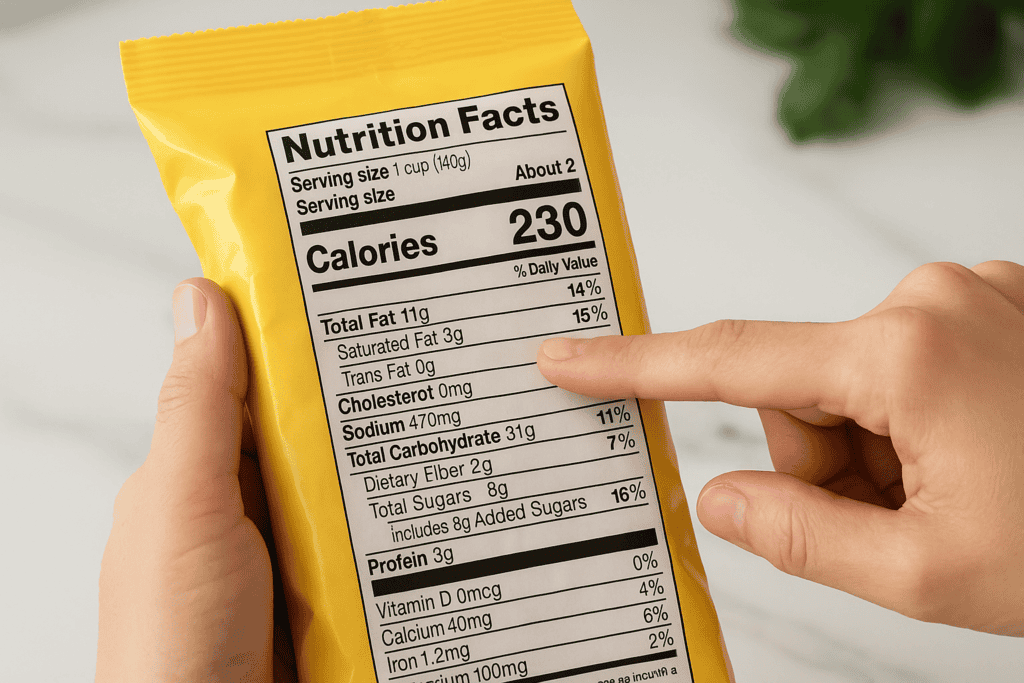
Reading food labels: what to look for and avoid
Understanding the ingredients list: order, additives, and hidden sugars
Ingredients appear in descending order by weight, so the first few items usually drive the product’s nutritional profile. Choose foods where recognisable whole ingredients sit near the top, and treat long lists of refined starches, oils, and sweeteners as a sign of heavier processing. Watch for additives, which manufacturers use to improve texture, colour, or shelf life. Some additives serve a clear purpose, yet a cluster of emulsifiers, flavour enhancers, and colourings can indicate a product designed for taste and stability rather than simple composition.
Hidden sugars often appear under multiple names, which can make a product seem less sweet than it is. Look for terms such as glucose syrup, dextrose, maltodextrin, invert sugar, rice syrup, and fruit juice concentrate. When several of these appear separately, each may sit lower on the list, while the combined sugar content remains high. Salt can also hide behind names such as sodium bicarbonate or monosodium glutamate. For definitions and labelling rules, consult the Food Standards Agency. If a product claims “no added sugar”, check whether concentrated juices or purees still provide significant free sugars.
Nutrition information panel: calories, fat, saturates, salt, and fibre
The nutrition information panel helps you compare products quickly, especially when you use the per-100 g figures. Focus on the nutrients that most affect health: energy (calories), fat, saturates, salt, and fibre.
Calories show how much energy a food provides. Higher-calorie foods can still fit a balanced diet, yet frequent high-calorie snacks can push daily intake up without improving nutrition. Use calories to compare similar items, such as two breakfast cereals, rather than judging a single food in isolation.
Total fat includes all fats present. Some foods contain mostly unsaturated fats, which support heart health when they replace saturated fat. Saturates (saturated fat) matter because high intakes raise LDL cholesterol for many people. As a practical guide, choose products with lower saturates per 100 g, particularly for everyday foods such as spreads, ready meals, and snacks. For context on fats, see the NHS guidance on fats.
Salt often hides in bread, sauces, soups, and processed meats. Labels may list “salt” directly, which already accounts for sodium. Aim for lower-salt options and treat high-salt foods as occasional choices, since excess salt increases blood pressure risk. The NHS salt advice explains recommended limits and common sources.
Fibre supports digestion and helps you feel fuller after meals. Higher-fibre choices often include wholegrains, pulses, vegetables, nuts, and seeds. When comparing similar foods, pick the option with more fibre per 100 g, while also checking salt and saturates.
- Prioritise: lower saturates and salt; higher fibre.
- Compare fairly: use per-100 g figures across brands and pack sizes.
- Watch trade-offs: a “low-fat” product may still contain high salt or low fibre.
Front-of-pack claims: what “low fat”, “no added sugar”, and “high protein” mean
Front-of-pack claims can help you scan a shelf quickly, yet the wording can hide important detail. In the United Kingdom, many claims follow set definitions, so it helps to know what the terms allow.
“Low fat” means a product meets a legal threshold for fat content, but the food may still contain plenty of sugar or salt. Some “low fat” yoghurts, for example, use added sweeteners to keep taste and texture. “Reduced fat” only promises a reduction versus the brand’s standard version, not a low level in absolute terms.
“No added sugar” means the manufacturer has not added sugars such as sucrose, honey, or syrups. The product can still contain naturally occurring sugars, including those from fruit juice or purée, which can raise the total sugar content. Check the nutrition panel for total sugars to confirm what you will actually consume.
“High protein” signals a higher proportion of energy from protein, yet it does not guarantee a balanced product. Some bars achieve the claim while remaining high in calories or saturates. For precise definitions, consult the UK guidance on nutrition and health claims from the UK Government.
Allergens and dietary suitability: allergens, traces, and certification marks
Allergen labelling helps people avoid ingredients that can trigger serious reactions. In the United Kingdom, labels must emphasise specified allergens within the ingredients list, often in bold. Check for clear statements such as “contains milk” and “contains nuts”, then read the full list because recipes can change.
“May contain” or “made in a factory that handles” warnings signal a risk of cross-contamination. Those statements matter most for people with severe allergies, since even trace amounts can cause harm. When a product claims suitability for a dietary pattern, look for credible certification marks rather than marketing language. For gluten avoidance, seek recognised gluten-free labelling that follows UK rules, and confirm details via the Food Standards Agency. For vegan or vegetarian suitability, check for independent logos and confirm that allergens such as milk or egg do not appear in the ingredients.
Red flags to avoid: ultra-processed cues, misleading terms, and portion tricks
Some labels signal heavy processing or marketing spin. Treat these cues as prompts to check the ingredients and nutrition panel before buying.
- Ultra-processed cues: long ingredient lists dominated by refined starches, added oils, flavourings, emulsifiers, thickeners, or sweeteners. A product can still fit an occasional diet, yet these markers often align with higher energy density and lower fibre.
- “Healthy” language without specifics: terms such as “natural”, “wholesome”, “farmhouse”, or “artisan” have no consistent nutrition standard. Use them as branding, not evidence.
- Sweetness by another route: “no added sugar” can still mean high sugar if the product uses fruit juice concentrate, purées, or naturally sweet ingredients in large amounts.
- Salt and fat disguised: watch for sodium (salt), stock, yeast extract, cheese powders, or cured meats, which can raise salt. Coconut oil, palm oil, and butter can lift saturates.
Portion tactics can also mislead. A small stated serving can make sugar, salt, or calories appear modest, even when most people eat more. Compare the per-100 g figures across similar products, then check how many servings the pack contains. Multi-portion packs often look reasonable per serving, yet the full pack can add up quickly.
Be cautious with “light” or “lighter” claims, which usually mean reduced compared with the brand’s standard version, not low in absolute terms. “High protein” can also distract from high calories, saturates, or salt in bars, shakes, and ready meals.
When in doubt, use a trusted reference for claim rules and label terms. The NHS guidance on reading food labels explains common label features in plain language and helps you sense-check marketing against the numbers.
Frequently Asked Questions
What information must a UK food label legally include?
UK food labels must show: the food name; ingredients list with allergens emphasised; quantity of certain ingredients (QUID) where required; net quantity; use-by or best-before date; storage and use instructions; business name and address; country of origin or place of provenance when required; nutrition information; and an alcohol strength statement for drinks above 1.2% ABV.
How can serving size and portion information affect the nutrition values shown on a label?
Nutrition values usually apply to a stated serving, not the whole pack. If the serving size is smaller than the portion eaten, the label can understate calories, sugar, salt, and fat. Compare “per 100 g” with “per serving”, check the number of servings per pack, and adjust figures to match the portion.
Which ingredients or additives should people limit or avoid when reading food labels?
Limit added sugars (glucose-fructose syrup, dextrose), high salt (sodium), and industrial trans fats (partially hydrogenated oils). Avoid artificial sweeteners if sensitive. Reduce intake of certain additives, such as monosodium glutamate (MSG), sulphites, and some colours (for example, tartrazine). Prefer shorter ingredient lists with recognisable foods.
How do front-of-pack traffic light labels relate to the full nutrition information panel?
Front-of-pack traffic light labels give a quick summary of key nutrients (fat, saturated fat, sugars, and salt) per 100 g or 100 ml, using colour and numbers. The full nutrition information panel provides the complete breakdown, often including energy, protein, fibre, and portion values. Use the traffic light as a guide, then confirm details on the panel.
What do common nutrition claims such as “low fat” or “no added sugar” mean on UK food labels?
UK nutrition claims follow set rules. “Low fat” means no more than 3 g fat per 100 g (solids) or 1.5 g per 100 ml (liquids). “No added sugar” means no sugars were added, but the food may still contain natural sugars. Check the nutrition table and ingredients list.