
Hydration advice often relies on slogans rather than evidence. Claims such as “eight glasses a day” or “thirst means dehydration” can mislead, because fluid needs vary by body mass, climate, diet, and activity.
This guide separates myths from facts using measurable markers such as urine colour, sweat losses, and typical daily intake ranges. Most adults consume about 2–3 litres of total water per day from drinks and food, while endurance exercise can raise losses to 1–2 litres per hour. Understanding these numbers helps prevent both dehydration and overhydration.
Key takeaways
- The “eight glasses a day” rule lacks evidence; needs vary by body size.
- Thirst usually signals hydration needs; most healthy adults can trust it.
- Coffee and tea contribute to fluid intake; moderate caffeine does not dehydrate.
- Clear urine is not a goal; pale straw colour indicates adequate hydration.
- Sports drinks suit long, intense exercise; water works for most daily activity.
- Electrolytes matter during heavy sweating; excess water can cause hyponatraemia.
Hydration basics: how the body regulates water and electrolytes
Water accounts for about 60% of an adult’s body weight, and blood plasma is roughly 90–92% water, which makes fluid balance central to circulation and temperature control (USGS). The body regulates hydration through a tight feedback loop: the brain’s hypothalamus detects rising blood osmolality (concentration) and triggers thirst, while the pituitary releases antidiuretic hormone (ADH) to reduce water loss in urine. Even a small shift in concentration prompts action; normal blood osmolality typically sits around 275–295 mOsm/kg (Merck Manual Professional Edition).
Electrolytes, especially sodium and potassium, govern where water moves between cells and blood. Sodium dominates the fluid outside cells, so sodium losses through sweat can destabilise volume and blood pressure during prolonged exercise or heat exposure. Sweat sodium varies widely, but many adults lose roughly 0.5–1.5 g of sodium per litre of sweat, which explains why plain water alone may not restore balance after heavy sweating (ACSM). The kidneys then fine-tune both water and sodium, filtering about 180 litres of fluid per day and reabsorbing nearly all of it to keep levels within a narrow range.
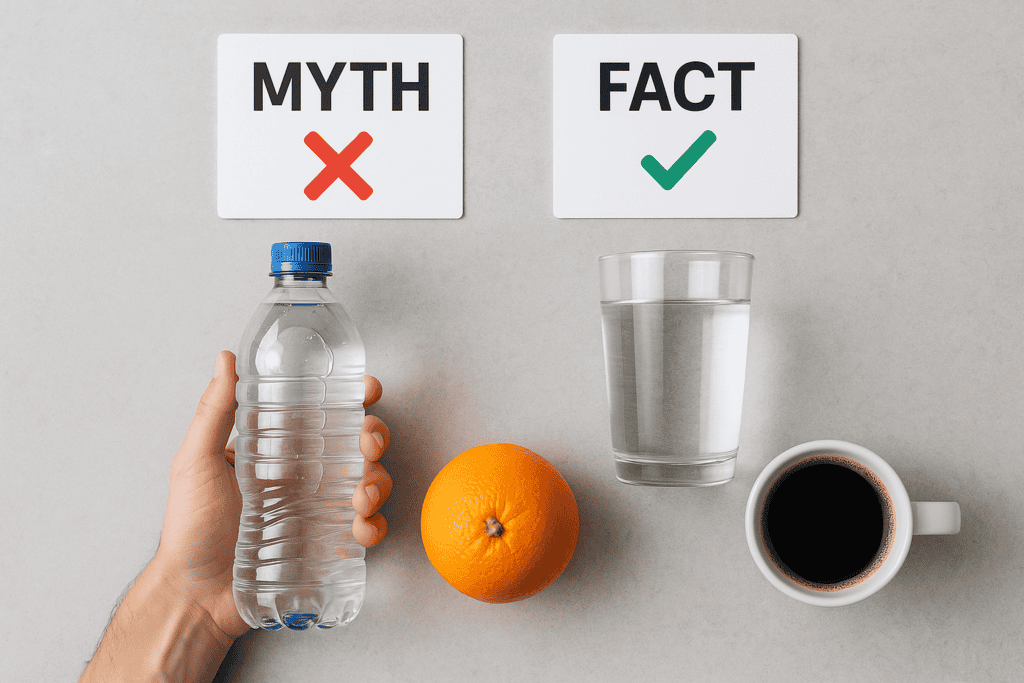
Hydration myths vs. facts
Myth: everyone needs eight glasses a day — Fact: needs vary by body size, diet, and climate
At 15:00 on a July afternoon in Seville, a 55 kg tourist carries a 1 litre bottle and aims to “hit eight glasses” before dinner. Two streets away, a 95 kg construction worker drinks the same amount, yet finishes the shift with a headache and dark urine. The rule sounds tidy, but the outcomes differ because **fluid needs scale with heat load and body mass**, not a single number.
Water turnover rises with size and activity. The National Academies set adequate intakes at about 3.7 litres/day for men and 2.7 litres/day for women from all beverages and foods, not eight 240 ml glasses. Climate shifts requirements quickly: sweat rates during moderate-to-hard work in heat commonly reach 0.5–1.5 litres per hour (CDC), which can exceed a full day’s “eight glasses” in a single afternoon.
Diet also changes the target. High-salt meals increase thirst, while water-rich foods contribute meaningfully; the USDA estimates foods provide roughly 20% of daily water intake for many adults. A practical approach uses **thirst and urine colour** as day-to-day checks, then increases fluids during heat, long exercise, fever, or diarrhoea.
Myth: thirst is a poor guide — Fact: when thirst works and when it does not
Option A (myth): thirst lags behind dehydration, so it cannot guide drinking. Option B (fact): thirst usually tracks rising blood concentration and helps most healthy adults match intake to losses during routine days.
In controlled studies, people with free access to water often maintain body mass within about 1% across a day, which indicates that thirst and normal drinking habits can keep fluid balance close to baseline. The brain’s osmoreceptors typically trigger thirst after a small rise in plasma osmolality, often corresponding to roughly 1–2% body water deficit.
| Situation | How well thirst works | What to do in practice |
|---|---|---|
| Normal daily activity in temperate conditions | Usually reliable for maintaining near-steady hydration | Drink when thirsty; check urine colour and frequency |
| Prolonged exercise or heavy work in heat | May under-shoot needs as sweat losses rise quickly | Plan fluids; aim to limit body mass loss to <2% (ACSM) |
| Older age or illness affecting thirst | Often blunted; higher risk of under-drinking | Use scheduled drinks and monitor weight and urine output |
Practical implication: treat thirst as a solid baseline signal, then add structure when heat, duration, or physiology reduces its accuracy. For sport and occupational heat, follow guidance from the American College of Sports Medicine and adjust using body mass change and urine cues.
Myth: clear urine means perfect hydration — Fact: practical markers and warning signs
A common mistake in hydration tracking comes from treating crystal-clear urine as a success metric. Urine colour changes quickly with fluid intake, so a single pale sample can mask meaningful losses from sweat or diarrhoea. In endurance settings, athletes can lose 0.5–2.0 litres of sweat per hour depending on heat and intensity, which can outpace casual sipping even when urine looks light (American College of Sports Medicine, ACSM).
Use practical markers that reflect both intake and losses. Aim for urine that stays pale straw across the day, not colourless every time. Pair that with body-mass change: a drop of more than 1% from morning to afternoon often signals underhydration during active or hot days, while rapid gain can indicate overdrinking. For context, the CDC lists diarrhoea and vomiting as key dehydration risks, where fluid and electrolyte replacement matters more than urine colour alone.
Implement a simple routine: weigh once after waking and once after work or training, under similar conditions; note urine colour at midday; and adjust fluids in small doses (200–300 ml) every 20–30 minutes during heavy sweating. Seek medical help if warning signs appear, including confusion, fainting, no urination for 8+ hours, or persistent dizziness.
People who combine these checks usually reduce headaches and fatigue during heat exposure and stabilise day-to-day weight swings to within about 1%, which indicates steadier fluid balance.
Hydration in practice: evidence-based intake ranges, timing, and drink choices
In 2023, the National Academies of Sciences, Engineering, and Medicine set adequate intake for total water at 3.7 litres/day for men and 2.7 litres/day for women, including water from drinks and foods. These figures work as planning anchors, not strict targets, because sweat losses can shift daily needs by more than a litre. Treat the numbers as a baseline, then adjust using body mass change, urine output, and heat exposure.
For most healthy adults, timing matters less than matching intake to losses across the day. A practical check uses body mass: a drop of >1% from morning to evening often signals under-drinking, while repeated gains can indicate over-drinking. During prolonged exercise, aim to limit body mass loss to roughly 0–2%, which aligns with sports medicine guidance for maintaining performance without excessive fluid intake.
- Routine days: drink with meals and between them; include water-rich foods, which contribute roughly 20% of total water intake in many diets.
- Heat or long sessions: use a scale when possible; replace fluids progressively rather than in one large bolus.
- High sweat rates: plan for losses of 0.5–2.0 litres/hour in hot conditions, then tailor intake to tolerance and access.
Drink choice should reflect context. Water suits most situations, while oral rehydration solution (ORS) fits diarrhoea or heavy fluid loss because glucose improves sodium and water absorption in the gut. For exercise lasting over 60–90 minutes, a sports drink can help when it provides carbohydrate and sodium; check the label rather than relying on marketing. Avoid excessive plain-water intake during very long events, since dilution can contribute to hyponatraemia; the CDC highlights that sodium balance matters when fluid losses are high.
Frequently Asked Questions
Is the ‘eight glasses of water a day’ rule evidence-based for most adults?
No. The “eight glasses” rule is a simple guideline, not a universal, evidence-based target for most adults. The US National Academies suggest total daily water intake of about 3.7 litres for men and 2.7 litres for women, including fluids and food. Thirst, urine colour, activity, and climate provide better cues.
Do coffee and tea cause dehydration, or do they contribute to daily fluid intake?
Coffee and tea contribute to daily fluid intake for most adults. Although caffeine has a mild diuretic effect, studies show that moderate intake (about 3–5 cups of coffee per day, roughly 300–400 mg caffeine) does not cause dehydration in habitual consumers. Limit very high caffeine intake if dehydration risk is elevated.
Can clear urine indicate overhydration rather than optimal hydration?
Yes. Very clear or colourless urine can indicate overhydration, especially if it persists and you urinate frequently (for example, every 30–60 minutes). Optimal hydration usually produces pale straw-coloured urine. Drinking far beyond thirst can dilute blood sodium; severe hyponatraemia can cause headache, nausea, confusion, or seizures.
Does drinking water during meals impair digestion or nutrient absorption?
No. Drinking water with meals does not impair digestion or nutrient absorption in healthy people. Water supports saliva and stomach secretions, helping enzymes break down food. Studies show gastric emptying and absorption remain normal with typical fluid intakes (about 200–500 ml). Very large volumes may cause temporary bloating, not malabsorption.
Are electrolyte drinks necessary for hydration during typical daily activities and short workouts?
For most people, electrolyte drinks are not necessary for hydration during normal daily activities or short workouts. Water usually replaces fluid losses effectively, since typical sweat losses in a 30–60 minute session are often under 1 litre. Consider electrolytes after heavy sweating lasting over 60–90 minutes, or if heat increases sweat rates above 1 litre per hour.