
Seasonal eating means choosing fruit and vegetables harvested at their natural peak. In the United Kingdom, produce in season often travels fewer than 300 miles, compared with 1,500–3,000 miles for many imports, which can reduce transport costs and waste. A 2024 WRAP estimate links household food waste to around £17 billion each year, and planning meals around seasonal produce helps cut that loss. This guide explains what to buy, when to buy it, and how to store it for better nutrition and lower spend.
Key takeaways
- Seasonal produce typically costs less because supply peaks during local harvest windows.
- Fruit and vegetables picked in season often deliver better flavour and higher nutrient retention.
- Use a simple seasonal calendar to plan weekly meals around what is abundant.
- Swap out-of-season imports for frozen seasonal options to cut waste and save money.
- Buy in bulk when prices drop, then batch-cook soups, sauces, and stews.
- Store produce correctly to extend freshness, reducing spoilage and repeat shopping trips.
What Seasonal Eating Means and How It Works in the United Kingdom
In 2024, the United Kingdom imported about 47% of the food consumed domestically, leaving roughly 53% supplied by UK production (UK Government Food Statistics Pocketbook). Seasonal eating means choosing foods when UK growers harvest them at scale, rather than relying on out-of-season imports. This approach matters because it aligns purchases with peak supply, which typically improves freshness and can reduce price volatility driven by transport costs and global shortages.
Seasonality in the UK follows a clear production pattern. British asparagus usually peaks in April to June, while strawberries tend to peak from June to August; apples and pears dominate from September into late autumn. By contrast, tomatoes and cucumbers often shift towards greenhouse supply outside summer, which can change flavour and cost. The practical mechanism is simple: shoppers use harvest timing to guide choices, then rotate staples across the year, such as swapping winter brassicas for summer salad crops.
Seasonal eating also supports nutrition planning. The NHS recommends at least 5 portions of fruit and vegetables per day, and the Eatwell Guide advises that fruit and vegetables should make up just over one third of daily intake. Using seasonal produce helps households meet these targets with a wider rotation across 12 months, while keeping spend predictable.
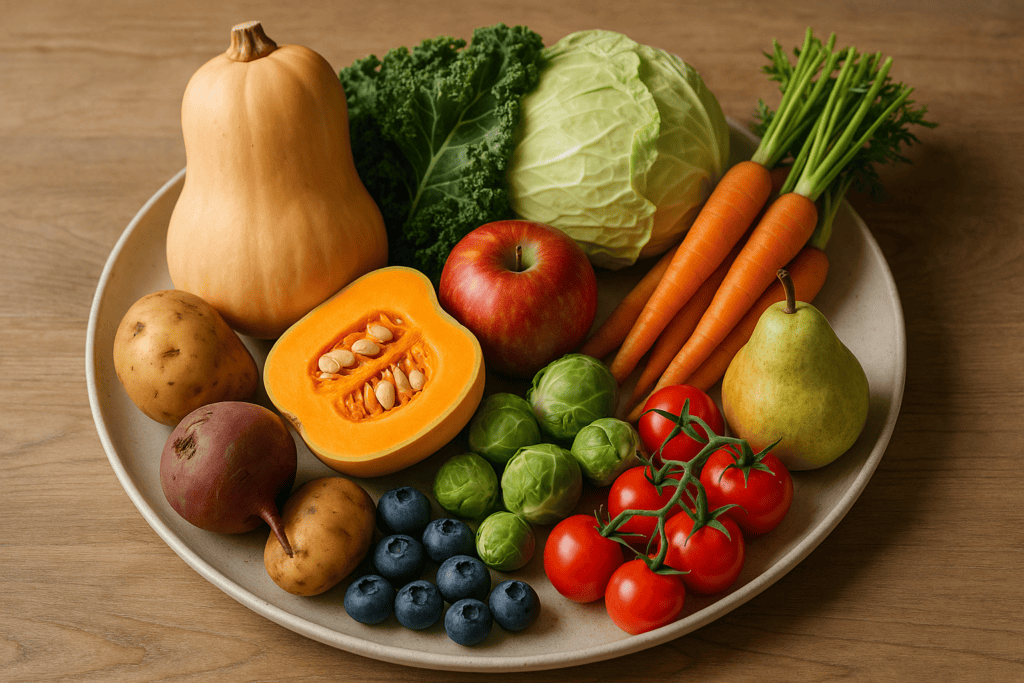
What Seasonal Eating Means
Nutrition Advantages of Seasonal Produce: Micronutrients, Fibre, and Variety
In July, a punnet of UK-grown strawberries bought the same morning at a farm shop often needs little more than a rinse before serving. That short journey from field to plate usually means less time for vitamin C to degrade, which helps explain why fresh strawberries provide about 59 mg of vitamin C per 100 g (around 65% of the UK daily reference intake) (NHS; USDA FoodData Central).
The same principle applies across seasonal produce: quicker harvesting and fewer days in storage can preserve fragile micronutrients, while ripeness improves flavour and encourages higher intake. Fibre remains a consistent advantage, and seasonal choices make it easier to reach the UK recommendation of 30 g per day by rotating vegetables, pulses, and fruit (SACN).
Over a year, variety becomes the main nutritional win. Spring greens, summer berries, autumn brassicas, and winter roots each bring different mixes of folate, potassium, and polyphenols, reducing reliance on a narrow set of staples and supporting a more balanced diet.
Cost Savings from Buying In-Season: Pricing Patterns and Household Budget Impact
Buying produce in season usually means paying for UK peak supply; buying out of season often means paying for imports, storage, and higher energy use. The contrast shows up most clearly in soft fruit and salad crops: UK strawberries and tomatoes tend to fall in price when domestic harvests peak, while winter supply relies heavily on imports and heated production.
Option A (in-season) benefits from short supply chains and higher volumes, which retailers can price more aggressively. Option B (out-of-season) carries extra costs such as longer transport distances, controlled-atmosphere storage, and, for some crops, heated glasshouse production. UK food supply also depends materially on trade: the UK imported about 47% of food consumed domestically in 2024, which exposes shoppers to exchange-rate and freight volatility (UK Government Food Statistics Pocketbook).
| Cost driver | Option A: In-season (UK peak) | Option B: Out-of-season | Budget impact |
|---|---|---|---|
| Supply volume | Higher domestic availability over 6–12 weeks for many crops | Lower availability, reliant on imports or stored stock | More frequent promotions and multi-buy pricing |
| Transport and handling | Shorter journeys and fewer handling stages | Longer journeys and more distribution steps | Higher unit costs, especially for perishable items |
| Energy and storage | Minimal long-term storage for many fruits and salads | Cold storage or heated production more common | Greater price variability across months |
For household budgets, the practical implication is timing: shifting just two weekly purchases to in-season alternatives can reduce the cost per portion without changing meal structure. A simple swap such as winter berries to apples or pears often cuts spend because apples store well and the UK harvest runs from late summer into autumn. Price changes also compound across the basket: if a family buys 5 kg of fruit and vegetables per week, a £0.30 per kg seasonal swing equates to about £78 per year.
Tracking prices by weight helps, because “per item” pricing hides size differences. Using the unit price on shelf labels and planning meals around two or three seasonal staples each week typically delivers the most consistent savings.
Season-by-Season UK Produce Calendar: Spring, Summer, Autumn, and Winter Staples
UK shoppers often miss seasonal value because supermarket ranges stay consistent year-round. In 2024, the average UK household spent about £4,000 on food and non-alcoholic drinks (ONS), so even a 5% seasonal saving equals roughly £200 per year. A simple season-by-season calendar reduces guesswork and shifts purchases towards peak UK supply, when quality and price usually improve.
Use a four-season framework anchored to typical UK harvest windows. Spring (March–May) centres on asparagus, spring greens, watercress, radishes, and early British strawberries from late May. Summer (June–August) peaks for tomatoes, courgettes, cucumbers, peas, sweetcorn, berries, and stone fruit, with the widest UK choice. Autumn (September–November) brings apples, pears, plums, pumpkins, beetroot, mushrooms, and brassicas. Winter (December–February) relies on storage and hardy crops such as leeks, parsnips, swede, carrots, kale, and sprouts.
Implement the calendar in three steps. Step one: plan two dinners each week around one seasonal vegetable and one seasonal fruit. Step two: buy “wonky” grades and larger packs when UK supply peaks, then freeze berries or blanch greens for later. Step three: verify origin on labels and cross-check harvest timing using BBC Good Food’s seasonal calendar or RHS crop guidance.
After four weeks, most households see fewer impulse purchases, better meal variety, and lower spend on out-of-season salad and soft fruit. Tracking receipts for 28 days makes the change measurable and repeatable.
How to Shop Seasonally: Supermarkets, Markets, and Box Schemes
In 2024, the average UK household spent about £4,000 on food and non-alcoholic drinks, so a 5% shift towards in-season produce equates to roughly £200 per year (Office for National Statistics). That saving becomes easier to capture when shopping habits match how retailers source: supermarkets stabilise ranges with imports, while markets and box schemes track UK harvest peaks more closely. As a result, the same budget buys higher-volume staples when domestic supply rises, and fewer premium-priced out-of-season items.
In supermarkets, use price per kilogram and country-of-origin labelling to identify seasonal value quickly; UK-grown lines typically expand during peak months, while imported equivalents dominate in winter. Pair that with reading food labels: what to check for added sugar or salt in “seasonal” ready foods, which can dilute the nutrition benefit. For context, UK production supplies about 53% of food consumed domestically, so origin cues often signal whether a product aligns with UK seasonality (UK Government Food Statistics Pocketbook).
Markets and farm shops usually offer shorter supply chains and clearer variety shifts week to week, which helps you plan meals around what is abundant. Box schemes add predictability: a typical weekly box weighs around 4–6 kg, which suits a household aiming for the NHS target of 5 portions of fruit and vegetables per day (NHS). Choose a “mixed seasonal” option, then build two or three flexible dinners around the contents to reduce waste and protect the savings.
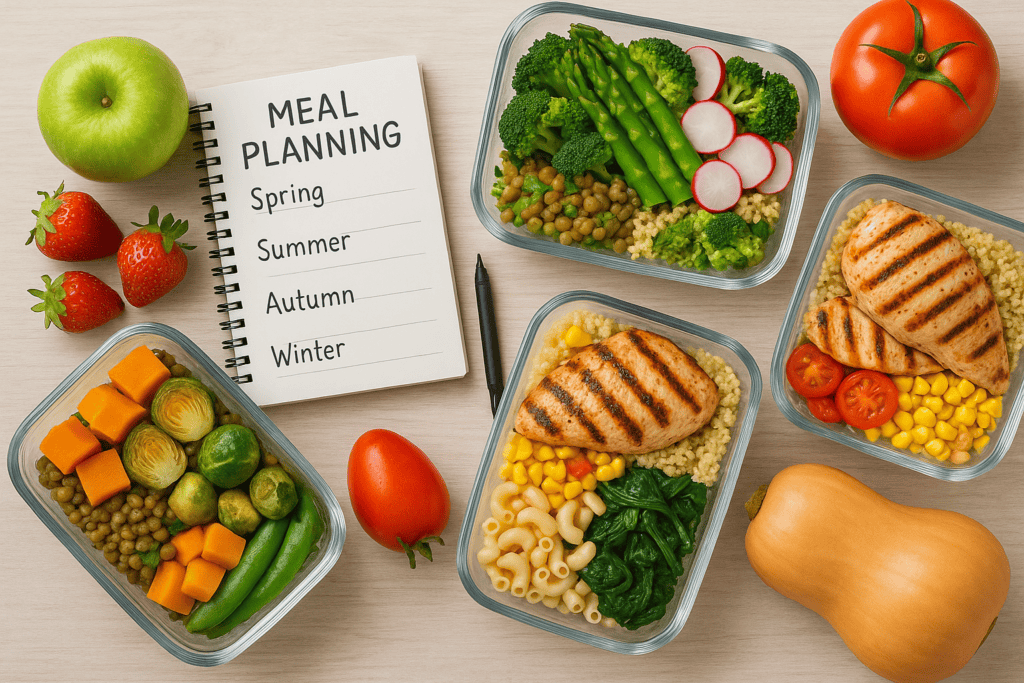
Meal Planning for Seasonal Eating
Meal Planning for Seasonal Eating: Batch Cooking, Freezing, and Reducing Food Waste
On a Sunday in October, a household returns from the market with 2 kg of butternut squash, 1 kg of carrots, and a large bag of onions because prices drop at peak harvest. That same evening, the cook roasts the vegetables, blends them into soup, and portions eight servings into 400 ml containers. Four portions go into the fridge for lunches; four go into the freezer for later weeks.
This approach protects both nutrition and budget. Freezing slows vitamin loss by halting enzyme activity, and research shows many frozen vegetables retain comparable vitamin C to fresh after storage (see NHS; USDA FoodData Central). It also reduces waste: UK households throw away about 6.4 million tonnes of food each year, much of it edible (WRAP).
Apply the same pattern across seasons: cook one large tray of in-season vegetables, convert it into two meals, and freeze portions before leftovers become waste.
Seasonal Eating on Special Diets: Vegetarian, Vegan, Gluten-Free, and Low-Sodium Options
Option A uses seasonal produce as the base for special diets; Option B relies on year-round substitutes and packaged “free-from” foods. A vegan winter plate built around UK brassicas and pulses can reach 25–30 g of fibre per day when meals include 150 g cooked lentils (about 12 g fibre) plus 200 g vegetables (NHS; USDA FoodData Central). By contrast, many gluten-free convenience products contain less fibre than whole grains and cost more per 100 g.
Key differences centre on sodium, protein quality, and ingredient control. Adults should limit salt to 6 g per day (about 2.4 g sodium) (NHS), yet soups, sauces, and meat-free ready meals can exceed 1.5 g salt per portion. Practical implications include choosing naturally gluten-free seasonal staples (potatoes, squash, oats labelled gluten-free) and using herbs, citrus, and roasted alliums to maintain flavour while keeping salt low.
Common Barriers and Practical Fixes: Availability, Time, and Family Preferences
Three barriers block seasonal eating for many UK households: limited local range in winter, lack of time on weekdays, and family resistance to unfamiliar vegetables. The cost of friction is measurable; in 2024 the average household spent about £4,000 on food and non-alcoholic drinks (ONS), so even small plan failures can erase a £200 annual saving from a 5% shift to in-season buying.
A practical fix uses a “core-and-swaps” approach: keep 6–8 repeat meals and change only the vegetables and fruit to match the month. Implementation starts with one 15-minute check of a UK seasonal calendar, then a fixed shopping rule: buy two in-season vegetables (about 2 kg total) and one fruit each week, plus one frozen option for gaps. Next, batch-prep one base (tray-roast or soup) to cover 6–8 portions, and introduce new produce in 10–20% of a familiar dish.
Households usually see faster weeknight cooking, fewer abandoned ingredients, and steadier acceptance from children and partners.
Frequently Asked Questions
How does seasonal eating improve nutrient intake compared with out-of-season produce?
Seasonal produce often reaches peak ripeness before harvest, which raises nutrient density. Vitamin C can drop by 15–55% within 1–2 weeks of cold storage, and some vegetables lose 25–75% of vitamin C after 7 days at room temperature. Shorter supply chains also reduce time, light, and heat exposure.
Which fruits and vegetables are typically in season in the UK during spring, summer, autumn, and winter?
UK seasonal produce typically includes: spring: asparagus, spring greens, radishes, rhubarb; summer: strawberries, raspberries, tomatoes, courgettes, peas; autumn: apples, pears, pumpkins, squash, kale; winter: Brussels sprouts, cabbage, leeks, parsnips, swede, clementines. Peak weeks vary by region and weather, so check local harvest calendars.
How much money can households save by planning meals around seasonal produce, and what factors affect the savings?
Households can typically save 10–30% on fruit and vegetable spending by planning meals around seasonal produce, equal to roughly £150–£450 per year for a £1,500 produce budget. Savings depend on local supply, import reliance, retailer promotions, buying loose versus pre-packed, choosing frozen when fresh is costly, and reducing waste through planned portions.
What are practical ways to store, freeze, or preserve seasonal produce to reduce food waste and extend savings?
Freeze berries and chopped vegetables on a tray, then bag and label; most keep 8–12 months at -18°C. Blanch green beans and broccoli for 2–3 minutes before freezing to retain colour and texture. Store apples and carrots at 0–4°C in perforated bags for 2–6 weeks. Preserve surplus by pickling in 5% vinegar or making jam.