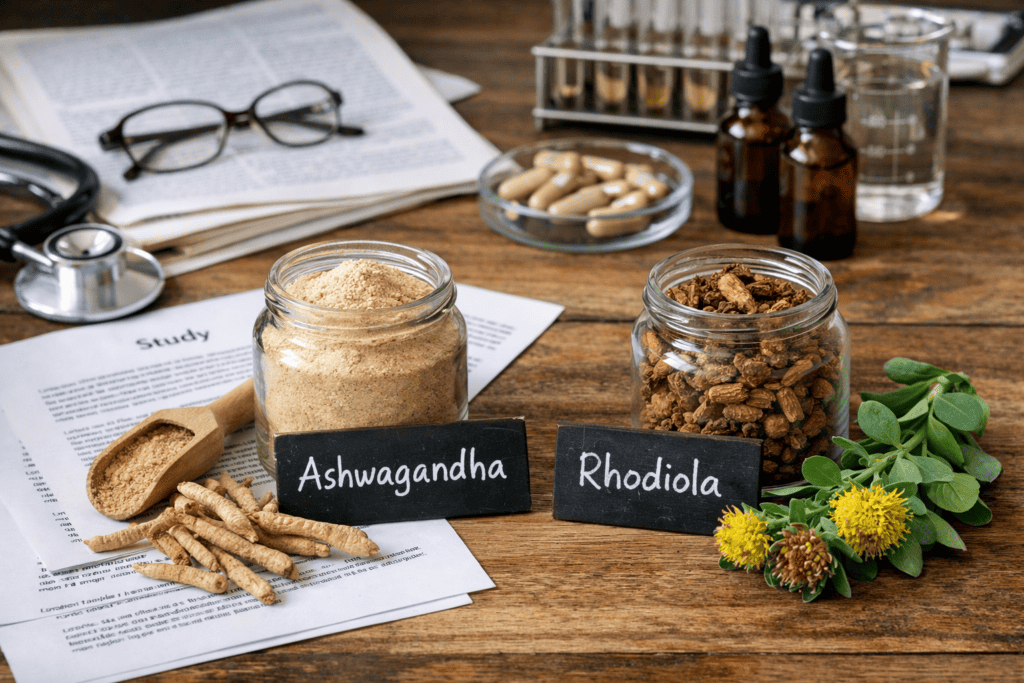
Adaptogens are plant-derived compounds that researchers study for their potential to help the body resist physical and psychological stress. The category includes dozens of herbs, but ashwagandha and rhodiola have the strongest base of clinical research. This article examines how each compound works, what the evidence supports, where the research falls short, and how to interpret the growing number of health claims attached to both.
Key takeaways
- Each adaptogen works through a different mechanism, so the category label alone tells you little.
- A 2019 RCT found that 240mg of standardised ashwagandha root extract reduced cortisol by around 23% over 60 days.
- Most Rhodiola rosea trials are small, short-term, and use inconsistent extract preparations.
- Adaptogens are not a substitute for SSRIs or other licensed treatments for clinical conditions.
- In the UK, adaptogens are sold as food supplements and cannot legally claim to treat any condition.
- Credible ashwagandha supplements state withanolide content, typically 2.5 to 5%, alongside the daily milligram dose.
- Review the clinical evidence for each specific herb before taking an adaptogen supplement.
What adaptogens are and how they are supposed to work
Review the clinical evidence for each herb before taking any adaptogen supplement. The category label tells you very little about likely effects. Adaptogens are plant-based or fungal compounds proposed to help the body resist physical, chemical, and biological stressors, but each herb works through a different mechanism.
The idea traces back to Soviet pharmacologist Nikolai Lazarev, who coined the term in 1947. The theory holds that certain compounds modulate the hypothalamic-pituitary-adrenal (HPA) axis, the hormonal pathway that governs the stress response, without pushing physiology towards a fixed outcome. Rather than sedating or stimulating, they are said to normalise.
That normalising effect is difficult to measure in practice and even harder to separate from placebo. Most human trials test adaptogens alongside lifestyle interventions, which makes it harder to attribute results to the herb alone. If you want to stay active and manage stress effectively, adaptogens work best alongside consistent movement and sleep, not as a replacement for either.
Ashwagandha: the clinical evidence and its limits
Ashwagandha (Withania somnifera) has more published human trial data than most other adaptogens. Cortisol reduction appears most consistently across the research. A 2019 randomised controlled trial published in Medicine found that 240mg of a standardised root extract daily reduced serum cortisol by around 23% over 60 days compared with placebo. Separate trials have also recorded improvements in self-reported stress, sleep quality, and endurance capacity in resistance-trained adults.
The limits of this evidence are significant. Most trials run for 8–12 weeks, involve fewer than 100 participants, and use proprietary extracts such as KSM-66 or Sensoril. These are not interchangeable with generic powders. Dosing also varies widely across studies, from 240mg to 600mg daily, which makes direct comparison difficult.
Cortisol reduction % from a 60-day RCT (600mg extract, n=64). PSS and HAM-A reductions are mean differences from a 2024 systematic review and meta-analysis of RCTs. Global data — UK-specific RCT unavailable.
Sources: Chandrasekhar et al., PMC (2012); BJPsych Open Meta-Analysis, Cambridge (2025)
Safety data at standard doses looks acceptable for short-term use. Still, rare cases of liver injury linked to ashwagandha supplements have been reported to pharmacovigilance databases in Europe and the US. People with thyroid conditions, autoimmune disorders, or those who are pregnant should consult a clinician before use, as the herb may interact with thyroid hormone levels and immunosuppressive treatment.
Rhodiola rosea: what research supports and what remains uncertain
Most published trials on Rhodiola rosea are small, short-term, and based on inconsistent extract preparations. The two active compounds studied most, rosavins and salidroside, appear to affect serotonin and dopamine availability. They may also dampen cortisol output via the hypothalamic-pituitary-adrenal axis. Whether these mechanisms lead to reliable clinical outcomes is where the evidence becomes more cautious.
A 2012 review published in Phytomedicine identified plausible anti-fatigue and cognitive effects under acute stress, but it also noted generally low trial quality. Cognitive performance and physical endurance have the most supporting data, although effect sizes remain modest. Anxiety reduction has been reported, but the evidence base is thinner than for ashwagandha.
| Factor | Ashwagandha | Rhodiola Rosea |
|---|---|---|
| Volume of human RCTs | Higher — multiple RCTs and meta-analyses available | Lower — 11 studies met inclusion in a systematic review; meta-analysis not possible due to inconsistent outcomes |
| Strongest evidence area | Cortisol reduction (statistically significant vs placebo across multiple trials) | Anti-fatigue and mental performance under stress (some positive signals) |
| Evidence quality | Moderate — trials are short (8–12 weeks), small (under 100 participants), often using proprietary extracts | Contradictory and inconclusive — methodological flaws limit accurate efficacy assessment |
| Typical study duration | 60–90 days | 2–8 weeks |
| Key limitation | Most trials use KSM-66 or Sensoril; not interchangeable with generic powder | No two studies measure the same outcomes; risk of bias largely 'unclear' |
| Safety profile | Generally well-tolerated; mild adverse events comparable to placebo | Generally well-tolerated; no serious adverse events reported in trials |
Sources: BJPsych Open Meta-Analysis (2025); Hung et al. – Rhodiola Systematic Review, PubMed (2012)
Standardisation remains the central problem. Products labelled as Rhodiola rosea vary significantly in their rosavin-to-salidroside ratio, and most trials do not disclose the exact preparation used. Until well-controlled trials establish consistent dosing parameters, the therapeutic profile remains promising but unresolved.
How adaptogens compare to conventional stress and fatigue treatments
Adaptogens are not a substitute for prescription medicines. SSRIs and benzodiazepines act on specific receptor systems and have well-characterised effects with regulatory approval. In the UK, adaptogens are sold as food supplements and are not licensed to treat any medical condition.
They may complement sleep hygiene, diet, and exercise for mild, subclinical fatigue or chronic stress that falls below a clinical threshold. These lifestyle measures have stronger and more consistent evidence across larger study populations. If a GP has recommended a pharmaceutical route, adaptogens do not replace it. Some compounds, including ashwagandha, interact with thyroid medications and sedatives, so check with a pharmacist before combining them. When adaptogens do have a role, they work best as a short-term adjunct at a clinically studied dose, using a standardised extract for a defined period rather than open-ended, unsupervised use.
How to evaluate adaptogen products and avoid misleading claims
Sources: HSIS – Food Supplements Regulations (UK); NHS Specialist Pharmacy Service – Understanding Food Supplements; Lexology – ASA & MHRA Wellness Brand Rulings (2025)
Claims like “supports wellbeing” fit within UK food supplement law. The law bans disease claims but allows vague function statements. That label wording tells you nothing about extract quality, dose, or standardisation.
Check the extract ratio and active constituent percentage. A credible ashwagandha supplement states withanolide content, typically 2.5 to 5%, alongside the daily milligram dose. Rhodiola products should declare rosavins and salidroside percentages. Without those figures, you cannot compare the product with the trials underpinning any claimed benefit.
Certification from Informed Sport or NSF International confirms independent testing for label accuracy and contaminant levels. These marks show that you are receiving what the label states, though they do not validate clinical evidence.
Avoid blends that combine six or more adaptogens at low individual doses. Manufacturers can list compounds linked to published research without providing trial-relevant quantities. They still benefit from the positive associations each name carries.
If your interest stems from fatigue, low mood, or disrupted hormone balance, clarify those goals first. Ashwagandha’s cortisol mechanisms differ from Rhodiola’s proposed influence on serotonin availability. The right choice depends on your specific symptom pattern.
Frequently Asked Questions
What are adaptogens, and how are they meant to affect the body?
Adaptogens are plant-based compounds that may help the body resist physical and psychological stress. They are thought to work by modulating the hypothalamic-pituitary-adrenal (HPA) axis, which governs the stress response. Rather than simply stimulating the body, their proposed effect is regulatory: normalising cortisol output and supporting recovery without overstimulating any single system.
What does the current evidence say about ashwagandha for stress, sleep, and performance?
Ashwagandha has more clinical trial data than most adaptogens. Randomised trials show modest reductions in cortisol and self-reported stress. They also report improvements in sleep onset and duration. Evidence for physical performance is thinner. Some studies show small improvements in VO2 max and muscle recovery.
What does research show about rhodiola for fatigue, focus, and exercise recovery?
Take rhodiola when mental fatigue or stress-induced exhaustion is the main concern. Clinical trials show that it reduces perceived effort and improves concentration during cognitively demanding tasks. Evidence for physical exercise recovery is weaker, although some studies report lower fatigue ratings after endurance activity.
Are adaptogens safe to take, and who should avoid ashwagandha or rhodiola?
Pregnant women, people with autoimmune conditions, and those taking thyroid or sedative medications should avoid both ashwagandha and rhodiola unless a clinician advises otherwise. Healthy adults generally tolerate short-term use at recommended doses well. Long-term safety data remains limited, so periodic breaks are advisable.
How can you assess the quality of adaptogen supplements and their claimed benefits?
Third-party testing marks like USP, NSF International, or Informed Sport show that a supplement contains what its label claims. Without them, no independent check confirms ingredient quality or dosage accuracy. Cross-reference any claimed benefits with peer-reviewed research on PubMed, and treat products that cite only animal or in-vitro studies with caution.